

A Voice Forged at the Intersection of Story, Justice, and the Land



Stories have always been how people carry the truth across generations. I came to screenwriting the same way I came to everything else—through the conviction that the stories we're not telling are the ones most worth telling. My scripts don't start from Hollywood formulas. They start from people: a fifteen-year-old Native girl who decides to fight a racist school board, a dying cowboy who has to reckon with a life of hard edges and harder choices, a Native man in recovery who stumbles onto something hidden beneath Portland's streets. Each story is rooted in specific place, specific culture, specific consequence. That's what makes them universal.
My writing pushes against the grain of easy answers. Whether it's a family drama set between Michigan and Hawaii or a limited series weaving together historical atrocities and present-day corruption, I write toward the complicated truth—the moment when a character can no longer pretend, when the cover story runs out. I've spent over thirty years doing cross-cultural work in some of the most contested spaces in North America, and that's the material I bring to the page. There's always a plenty of wry humor in there too, because if you can't laugh at the absurdity of what human beings do to each other, you'll never survive writing about it.
I don't work in a vacuum. My craft has been shaped by some of the most experienced people in the industry. My primary script consultant and mentor is Sabrina Parra, former Vice President at Di Novi Pictures and founder of The Scriptster—she has pushed my work toward professional industry standards without letting me flatten the Indigenous perspective that makes it distinctive. I've also worked with Rex McGee, a Hollywood story analyst whose credits span United Artists, Warner Bros., and The Ladd Company; Jeff Arch, Humanitas Prize winner and Academy Award, Golden Globe, Writers Guild, and BAFTA nominee; and David Paul Kirkpatrick, former production chief of Walt Disney Studios and former president of Paramount Pictures. These aren't names I drop lightly. Their investment in my work tells you something about what they see in it.
If you're new to the film industry, you may see references below to pitch decks and sizzle reels and wonder what those are. A pitch deck is a visual document—think of it as a short book of images, story description, character sketches, tone references, and market context—that gives producers and executives a feel for what a project is before they read the full script. A sizzle reel is a short video, usually two to four minutes, that captures the mood, stakes, and world of a project through music, imagery, and voice. Together they're a project's calling card. For many of my current projects, both are available upon request.


B I O G R A P H Y
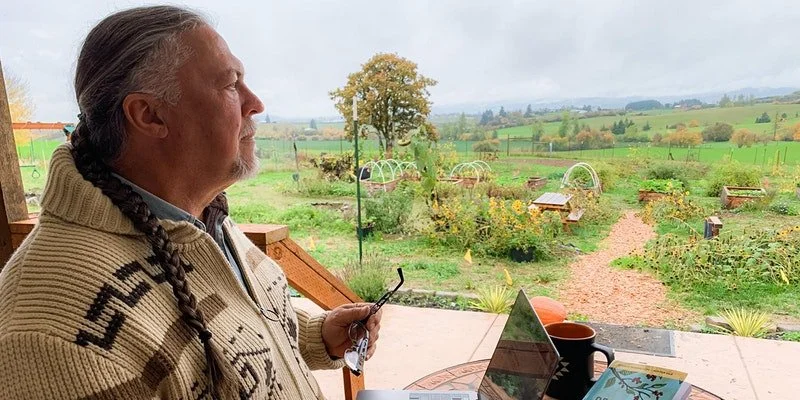
Randy Woodley writes with creativity and a deep passion oriented towards justice, Indigenous empowerment, earth care, and spirituality. His diverse background and experiences have uniquely equipped him to bring about positive change in his communities for over three decades.
Randy is an award-winning author and a tribally recognized Keetoowah Cherokee descendant. He weaves Indigenous wisdom, ecological sustainability, and spirituality in his writings. Randy is respected by Indigenous and non-Indigenous communities worldwide and has been featured in The New York Times, Politifact, Time Magazine, and The Huffington Post among other national venues.
With his wife Edith Woodley, Randy co-founded Sho-Kee Cultural Consultants in 2022 to bring cultural integrity to the entertainment industry. Edith is a member of the Eastern Band of Shoshone Indians with Choctaw, Crow, Paiute, Pi’ikanni, Flathead, Umatilla, and Mohawk heritage. The Woodleys have four children and six grandchildren.
Additional Projects Note
The projects below represent my current primary slate. I also have several additional feature screenplays and limited series at various stages of development—some with completed drafts, others moving through active rewrites—along with numerous treatments for future projects. Inquiries from filmmaking business professionals regarding any project, including projects not listed here, are welcome through the contact form below. All scripts and treatments are registered with the WGA.
Cultural Integrity in Every Project
Through Sho-Kee Cultural Consultants, Randy, his wife Edith Woodley, and their team, ensure that every project involving Indigenous or underrepresented cultures is developed with authentic community protocols, accurate representation, and genuine relationship. This is not a box to check. It is the foundation of the work.
→ Learn more at sho-kee.com
Feature Films
Cowboy Roy
"He ran from love—love ran faster."

Logline: Cowboy Roy is a Rom-Drama feature - about an older cowboy who's spent a lifetime running from love and has to decide which scares him more —the woman who sees right through him, the cancer, or the family homecoming waiting.
Set on the vast plains of West Texas, in 1969, Cowboy Roy is a coming-of-age story for a man in his sixties—which turns out to be the right age to finally grow up. When Roy encounters Indigenous healers who offer him something Western medicine couldn't, he's forced to sit still long enough to face himself. This is a story about the grace of second chances and the high cost of pride. Based on Randy Woodley's novel Cowboy Roy: When Love Comes Late. Pitch Deck and Sizzle Reel below.
Disclaimer: This is a writer's presentation piece. All talent depicted or named in this artwork represents the author's creative vision for the roles and does not indicate any casting commitment, representation agreement, or attachment of any kind. No actor, director, or other talent has been approached, contacted, or confirmed for these projects.
Far West
"The most powerful weapon against injustice is the truth—and one fifteen-year-old girl is about to wield it."
Logline: A fifteen-year-old Shoshone girl challenges Wyoming’s erasure of Native history — and claims the warrior birthright that was always hers.
A justice-focused coming-of-age story set in the contemporary American West, Far West weaves the historical erasure of Native peoples into a present-day fight for truth in education. Based on Randy Woodley's nonfiction work Walking the Great Divide, this film brings urgency and heart to the question every generation has to answer for itself: who gets to tell the story? Pitch Deck and Sizzle Reel below.

Disclaimer: This is a writer's presentation piece. All talent depicted or named in this artwork represents the author's creative vision for the roles and does not indicate any casting commitment, representation agreement, or attachment of any kind. No actor, director, or other talent has been approached, contacted, or confirmed for these projects.
Waiting on this Dream
"Some love stories take a lifetime to write."
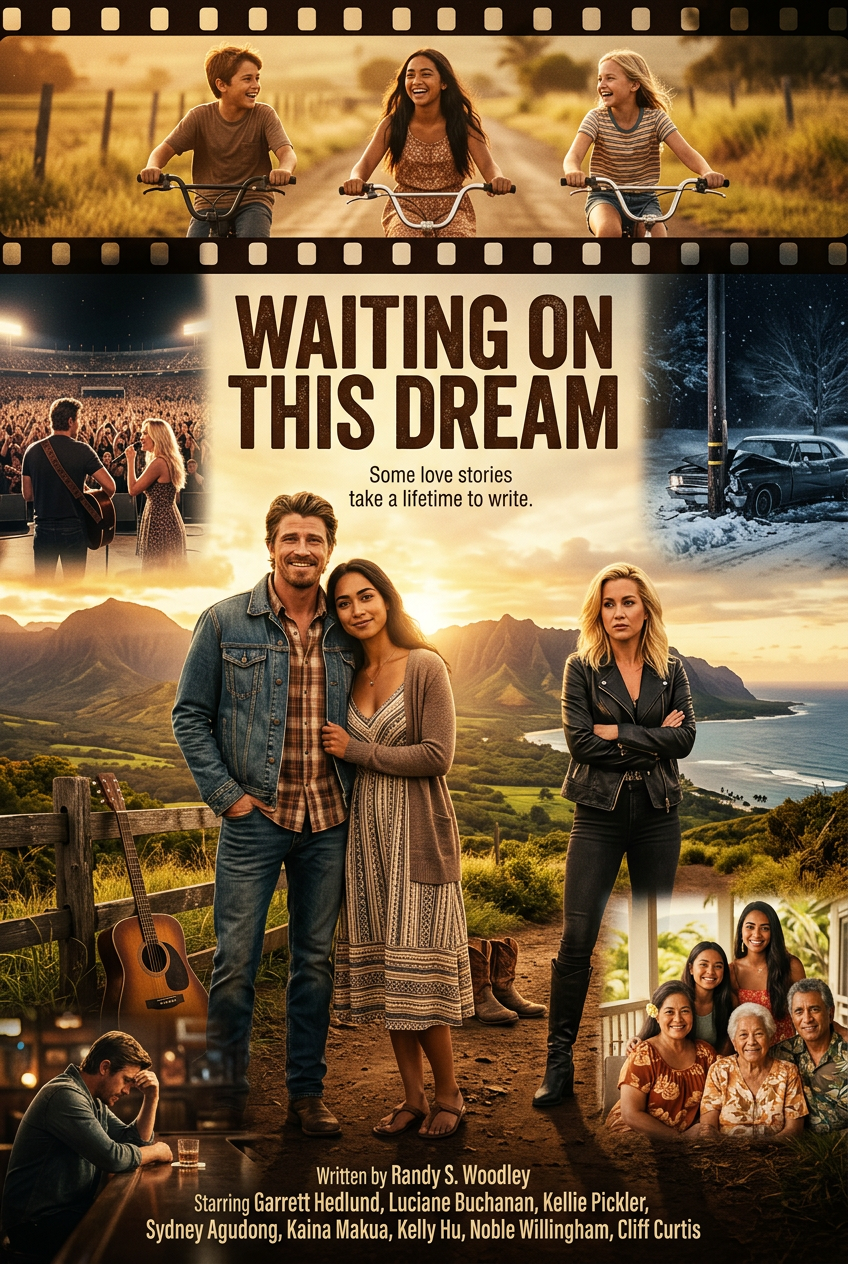
Logline: Kalani and Kris were always meant to be together, but when a devastating accident shatters his dreams of being a country singer, she becomes his path to healing—only to have the other woman return thirty years later, forcing them all to choose between fame and the family they've built.
Three friends grow up inseparable in small-town Michigan. Kris chases music with the wrong woman. A 1992 car crash puts him in a coma for a year. Cherlyn leaves for Nashville. Kalani stays. Thirty years later, an unexpected viral moment at age 51 gives Kris the second chance he thought was gone forever—and puts all three of them on a collision course in Hawaii. Think The Notebook meets A Star Is Born, grounded in the Hawaiian concept of o'hana—family above all. Original country songs are already written by Randy Woodley and his cousin, Rick Broadhead, and ready to record. Pitch Deck and Sizzle Reel below.
Disclaimer: This is a writer's presentation piece. All talent depicted or named in this artwork represents the author's creative vision for the roles and does not indicate any casting commitment, representation agreement, or attachment of any kind. No actor, director, or other talent has been approached, contacted, or confirmed for these projects.
Santa’s Romance Trilogy
"Show up. Give what you have. Believe it matters."
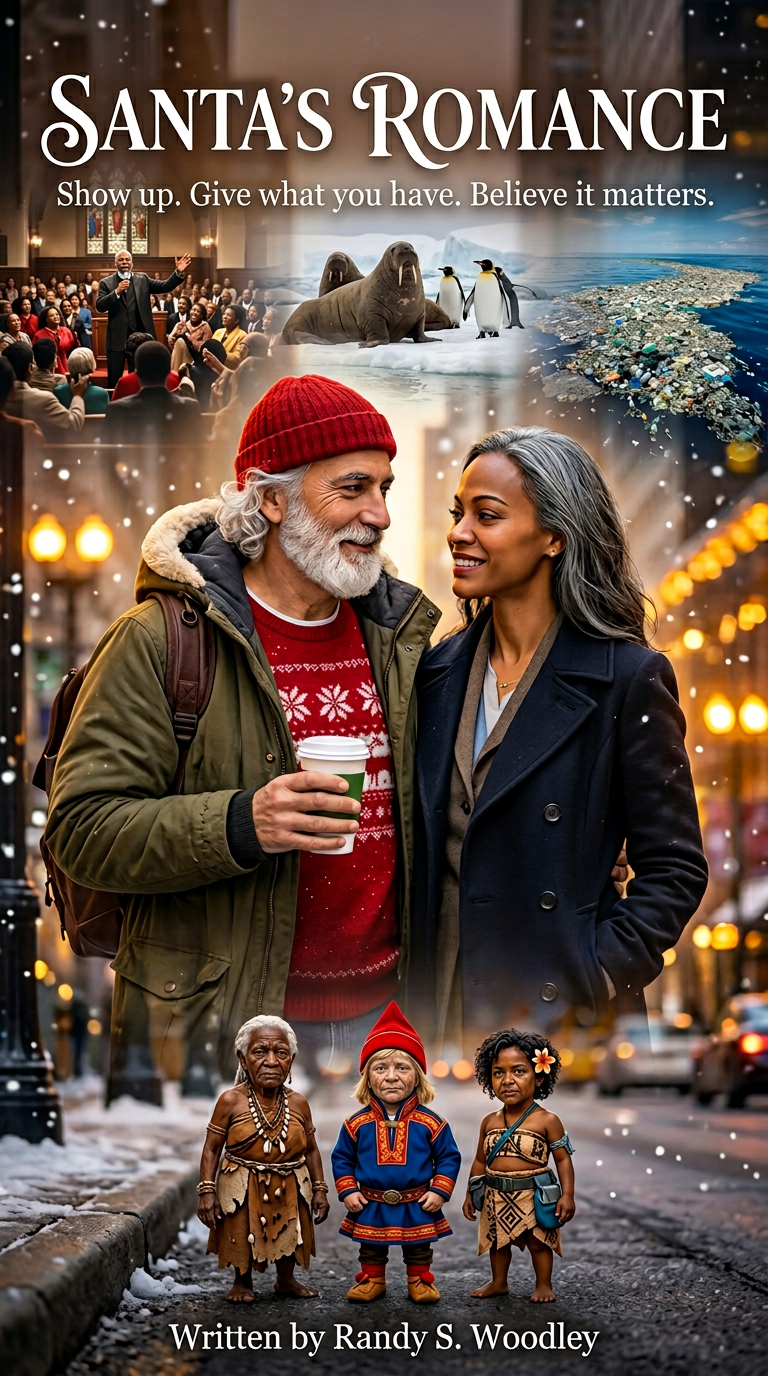
Logline: A seventeen-century-old gift-giver who has buried everyone he ever loved meets a fierce Afro-Latina social worker in modern Chicago — and discovers that the hardest thing he has ever done, is stay.
A literary fantasy trilogy rooted in decades of work at the intersection of Indigenous knowledge, environmental justice, and prophetic storytelling. Film One follows a 1,700-year-old immortal working as a Chicago mall Santa who meets Elena—a fierce, justice-minded Afro-Latina widow—and must choose between the grief that has defined him for centuries and a love that might finally redeem him. Screenplays for films Two and Three are in development. Screenplay for Film One script available upon request.
Disclaimer: This is a writer's presentation piece. All talent depicted or named in this artwork represents the author's creative vision for the roles and does not indicate any casting commitment, representation agreement, or attachment of any kind. No actor, director, or other talent has been approached, contacted, or confirmed for these projects.
Television/Limited Series
Rose City
"Some secrets run deep, but don't stay buried."

Logline: A recovering Native addict and three unlikely strangers unearth Rose City's century-old trafficking secret — buried underground, protected above ground — and force it into daylight.
Rose City opens in the 1890s, deep in Rose City's infamous Shanghai Tunnels, where the history of exploitation is not metaphor—it is literal. The series follows what happens when that history refuses to stay buried. Grounded in actual Portland geography and the long shadow of the city's founding crimes, this is crime drama with an Indigenous lens: systems don't protect everyone, and the people most likely to find the truth are the ones the system forgot. Based on a true story. Scripts for Pilot, Episodes 2 and 3 available. Pitch Deck and Sizzle Reel below.
Disclaimer: This is a writer's presentation piece. All talent depicted or named in this artwork represents the author's creative vision for the roles and does not indicate any casting commitment, representation agreement, or attachment of any kind. No actor, director, or other talent has been approached, contacted, or confirmed for these projects.
Contact
I'd love to hear from industry professionals — agents, managers, producers, show-runners, and development folks. If that's you, my inbox is open: elohehcenter@gmail.com